
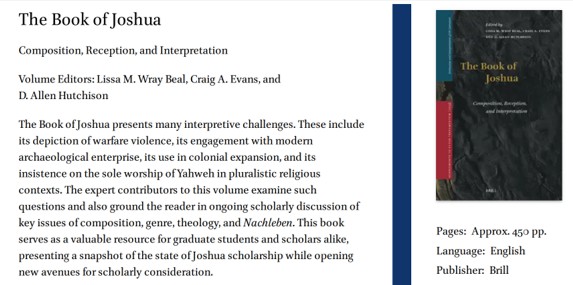
In many ways my essay is a pedagogical and scholar-friendly update of my dissertation from 1995 seen through the lenses of 30 years of research.
Chapter 12 Joshua and Modern Linguistics,
Modern linguistics has been modern for centuries, but to apply linguistics to the book of Joshua is a rather modern innovation. This essay introduces linguistics as a theoretical science on the structure and functions of language that can be applied to a book in Biblical Hebrew.
The aim is to introduce one of these modern approaches (section 1) and then with increasing complexity exemplify a linguistic approach at three different levels ranging from the verb to the use of language in Joshua. I will illustrate the grammar of Joshua first, by introducing basic linguistic concepts to explain the form of the verb in Biblical Hebrew (section 2.1). Second, I explain how meaning and function interact in the structure and function of clauses for a verb like give (section 2.2). Third, I introduce cutting-edge theory on focus structure and common ground (section 2.3). The final section presents corpus-linguistic data based on this new approach as inspiration for further study of the book of Joshua (section 3).
I appreciate the invitation and the great editorial support of especially Allan D. Hutchinson, but also suggestions by Lissa M. Wray Beal.
I am also proud to have my essay appear among contributions from colleagues I have had contact with and who are prominent in the scholarship on the Book of Joshua, like Rick Hess, Dan Block, K. Lawson Younger, J. Gordon McConville and Koert van Bekkum, as well as scholars I have been reading, like Thomas B. Dozeman, L. Daniel Hawk and Lissa M. Wray Beal, or listened to at conferences, like Ralph Hawkins and Leonard Greenspoon.
The only thing I regret is of course that many of my colleagues and students will not buy this valuable book, nor does their libraries have the money for this, and my colleagues and students in Africa can never in an entire lifetime save to own a copy. The publisher does not allow download for free trough Research Gate and Academia.
Here is a list of all the contributions:
Introduction by Lissa M. Wray Beal, Craig A. Evans, and D. Allen Hutchison, 1–4
Part 1 General Topics
Chapter 1 History of Research on the Composition of Joshua in the Modern Era by Thomas B. Dozeman 7–26
Chapter 2 Archaeology and the Book of Joshua by Ralph K. Hawkins, 27–52
Chapter 3 Joshua and “Total Kill” Language: Insights from Biblical and Genocide Studies, by Gordon Oeste, 53–72
Chapter 4 Joshua: Genre and Purpose, Richard S. Hess, 73–87
Chapter 5 Reading Joshua as a Narrative Whole: One Narrative, Three Narrators, by L. Daniel Hawk, 88–105
Chapter 6 The Torah of Moses in the Book of Joshua, Daniel I. Block, by 106–128
Part 2 Issues in Interpretation
Chapter 7 The Battle Accounts in Joshua and Ancient Near Eastern Comparisons K. Lawson Younger Jr., by 131–155
Chapter 8 Understanding the Town Lists and Border Documents in Joshua 12–21, Chris McKinny, 156–178
Chapter 9 Worship and Identity: the Role of Joshua 22 in the Book of Joshua by Lissa M. Wray Beal, 179–193
Chapter 10 The Ending(s) of the Book of Joshua, by Phillip Marshall, 194–213
Chapter 11 Gender Issues and the Role of Women in Joshua, by Hélène Dallaire, 214–234
Chapter 12 Joshua and Modern Linguistics, by Nicolai Winther-Nielsen, 235–258
Part 3 Textual Transmission
Chapter 13 The Book of Joshua: MT and LXX and Cognate Texts, by Dionisio Candido and Kristin De Troyer, 261–278
Chapter 14 Paraphrase and Rewriting at Qumran, by Leonard Greenspoon z”l, 279–295
Chapter 15 The Figure of Joshua in the Apocrypha and Pseudepigrapha of Second Temple Judaism, by William Adler, 296–311
Chapter 16 Joshua in the New Testament, by Israel Steinmetz, 312–334
Chapter 17 Aramaic Joshua, by Craig A. Evans, 335–354
Part 4 Theology and Reception History
Chapter 18 A Theology of The Land in Joshua by David G. Firth, 357–371
Chapter 19 Theological Themes in Joshua by John Goldingay, 372–388
Chapter 20 Joshua in the Larger Canon by J. Gordon McConville, 389–403
Chapter 21 Joshua, Violence, and Settler Colonialism by Stephen B. Chapman, 404–423
Chapter 22 Joshua Through the Eyes of Nineteenth- Century Women by Marion Ann Taylor and Christiana de Groot, 424–445
Chapter 23 Reading Joshua 24 in Modern Contexts of Religious Pluralism by Koert van Bekkum, 446–462